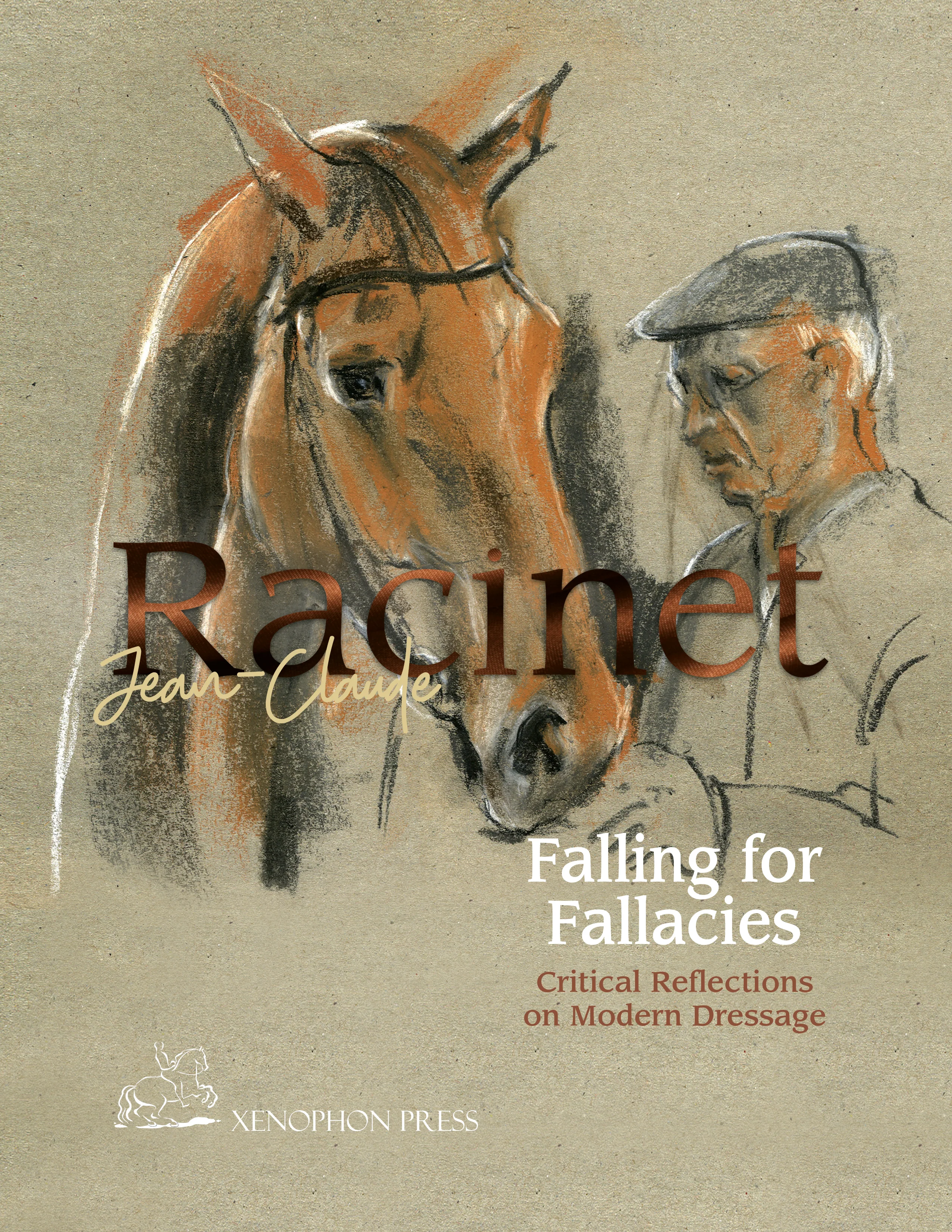
Falling for Fallacies: Critical Reflections on Modern Dressage (hardcover) by Jean-Claude Racinet
NOW IN PRINT
IN STOCK
ORDER YOUR COPY TODAY!
The world of modern dressage rests upon a body of doctrines so frequently repeated that they are seldom examined. Terms such as “on the bit,” “engagement,” and “collection” circulate through lessons, clinics, and rulebooks alike—yet how many riders can clearly define what these words truly mean in anatomical and bio-mechanical terms?
This forthcoming Xenophon Press publication undertakes a comprehensive and uncompromising review of contemporary dressage theory. It asks the difficult questions: Does stronger driving actually bring the hind legs further under the body? Is collection merely increased forward thrust? What truly happens within the horse’s musculoskeletal system when we apply the aids?
Grounded in anatomical science and functional biomechanics, this work separates inherited habit from physiological reality. It challenges unexamined assumptions, exposes contradictions in common training doctrine, and offers a clear, horse-centered framework rooted in observable fact rather than tradition alone.
At once analytical and practical, this book is not an attack on dressage—but a defense of it. By clarifying the sense and nonsense of widely accepted principles, it seeks to restore intellectual honesty and promote genuinely horse-oriented equitation.
A serious and thought-provoking contribution to the classical canon, and an essential volume for riders, trainers, and judges who care about truth as much as performance.
A critical analysis of modern dressage doctrines
What does it really mean to drive the horse ‘onto the bit’? Does a stronger application of the rider’s aids really encourage the horse to place its hind legs further under its body? Is the term ‘collection’ really synonymous with the increased forward engagement of the hind legs under the centre of balance?
Jean-Claude Racinet subjects these and other commonly held assumptions regarding the anatomical and biomechanical aspects of horse riding to a critical analysis, and in this context uncovers many wrongly-held beliefs that so far have never been que- stioned, either individually or as a system. This book points a spotlight at the many doctrines and half-truths embedded in modern dressage riding. It will set the reader thinking and will make an important contribution to the current debate on the correct approach to dressage training.
From the contents
-
Will engagement of the hind legs always lighten the front end?
-
Are collection and engagement of the hind legs really synonymous?
-
Does lifting a horse’s neck result in hollowing its back?
-
Does the centre of gravity of a collected horse really move backwards?
-
Should the horse be ‘pushed onto the bit’ by the rider’s legs and seat?
Jean-Claude Racinet is renowned world-wide as one of the most esteemed trainers of the French tradition of Légèreté. His basic and advanced training took place, amongst other schools of equitation, at the School of Cavalry in Saumur. In later years, he became a professional trainer, emigrating to the United States in the 1980s. He is well known as the author of a number of books on riding and Légèreté and has also written widely on the classical form of equitation. Jean-Claude Racinet passed away in April 2009. This is his final work.
From the back cover:
Falling for Fallacies and the Myths We Inherit
There are books that explain riding—and there are books that compel us to rethink it from the ground up. This is one of the latter.
In Falling for Fallacies, widely accepted principles of dressage are taken apart with uncommon precision. Ideas repeated across generations—engagement of the hind legs, collection, contact, impulsion, “connection”—are not dismissed, but examined. What do they actually mean? Where do they come from? And why do they so often fail in practice?
At the heart of the problem is what the author calls the “wooden tongue” of dressage: a language of familiar phrases that sound convincing, yet frequently conceal vague, contradictory, or incomplete thinking . Riders are told that contact becomes both stronger and lighter, that opposing aids produce harmony, that a horse becomes light by being driven forward into restraint—assertions that, when tested, often produce exactly the opposite result.
This book does not offer a new system. It does something more valuable: it restores clarity.
Drawing on a deep knowledge of classical sources—and written in the spirit of Jean-Claude Racinet’s uncompromising intellectual honesty—each chapter isolates a commonly accepted belief and subjects it to careful scrutiny. The result is cumulative and often unsettling. Assumptions begin to fall away. Contradictions become visible. And what remains is a more coherent understanding of the horse, the rider, and the work itself.
For the serious rider, trainer, or student of classical horsemanship, this is not casual reading. It is a book to be studied, tested, and returned to.
Inside this book:
- A systematic examination of foundational dressage concepts
- Clear analysis of “engagement,” “collection,” “contact,” and “connection”
- Why common training methods often produce heavy, resistant, or explosive horses
- The hidden contradictions in widely accepted riding doctrine
- A return to first principles grounded in the horse’s physiology and reality
Published by Xenophon Press—home to the English-language works of Jean-Claude Racinet (Another Horsemanship, Total Horsemanship, Racinet Explains Baucher)—this volume stands as a natural and necessary continuation of that tradition.
For those willing to question what they have been taught, Falling for Fallacies offers something rare: not another method, but a clearer way of thinking.
ISBN: 9798869214553
ALL COLOR HARDCOVER WITH MANY ILLUSTRATIONS
Original: $65.00
-65%$65.00
$22.75Product Information
Product Information
Shipping & Returns
Shipping & Returns
Description
NOW IN PRINT
IN STOCK
ORDER YOUR COPY TODAY!
The world of modern dressage rests upon a body of doctrines so frequently repeated that they are seldom examined. Terms such as “on the bit,” “engagement,” and “collection” circulate through lessons, clinics, and rulebooks alike—yet how many riders can clearly define what these words truly mean in anatomical and bio-mechanical terms?
This forthcoming Xenophon Press publication undertakes a comprehensive and uncompromising review of contemporary dressage theory. It asks the difficult questions: Does stronger driving actually bring the hind legs further under the body? Is collection merely increased forward thrust? What truly happens within the horse’s musculoskeletal system when we apply the aids?
Grounded in anatomical science and functional biomechanics, this work separates inherited habit from physiological reality. It challenges unexamined assumptions, exposes contradictions in common training doctrine, and offers a clear, horse-centered framework rooted in observable fact rather than tradition alone.
At once analytical and practical, this book is not an attack on dressage—but a defense of it. By clarifying the sense and nonsense of widely accepted principles, it seeks to restore intellectual honesty and promote genuinely horse-oriented equitation.
A serious and thought-provoking contribution to the classical canon, and an essential volume for riders, trainers, and judges who care about truth as much as performance.
A critical analysis of modern dressage doctrines
What does it really mean to drive the horse ‘onto the bit’? Does a stronger application of the rider’s aids really encourage the horse to place its hind legs further under its body? Is the term ‘collection’ really synonymous with the increased forward engagement of the hind legs under the centre of balance?
Jean-Claude Racinet subjects these and other commonly held assumptions regarding the anatomical and biomechanical aspects of horse riding to a critical analysis, and in this context uncovers many wrongly-held beliefs that so far have never been que- stioned, either individually or as a system. This book points a spotlight at the many doctrines and half-truths embedded in modern dressage riding. It will set the reader thinking and will make an important contribution to the current debate on the correct approach to dressage training.
From the contents
-
Will engagement of the hind legs always lighten the front end?
-
Are collection and engagement of the hind legs really synonymous?
-
Does lifting a horse’s neck result in hollowing its back?
-
Does the centre of gravity of a collected horse really move backwards?
-
Should the horse be ‘pushed onto the bit’ by the rider’s legs and seat?
Jean-Claude Racinet is renowned world-wide as one of the most esteemed trainers of the French tradition of Légèreté. His basic and advanced training took place, amongst other schools of equitation, at the School of Cavalry in Saumur. In later years, he became a professional trainer, emigrating to the United States in the 1980s. He is well known as the author of a number of books on riding and Légèreté and has also written widely on the classical form of equitation. Jean-Claude Racinet passed away in April 2009. This is his final work.
From the back cover:
Falling for Fallacies and the Myths We Inherit
There are books that explain riding—and there are books that compel us to rethink it from the ground up. This is one of the latter.
In Falling for Fallacies, widely accepted principles of dressage are taken apart with uncommon precision. Ideas repeated across generations—engagement of the hind legs, collection, contact, impulsion, “connection”—are not dismissed, but examined. What do they actually mean? Where do they come from? And why do they so often fail in practice?
At the heart of the problem is what the author calls the “wooden tongue” of dressage: a language of familiar phrases that sound convincing, yet frequently conceal vague, contradictory, or incomplete thinking . Riders are told that contact becomes both stronger and lighter, that opposing aids produce harmony, that a horse becomes light by being driven forward into restraint—assertions that, when tested, often produce exactly the opposite result.
This book does not offer a new system. It does something more valuable: it restores clarity.
Drawing on a deep knowledge of classical sources—and written in the spirit of Jean-Claude Racinet’s uncompromising intellectual honesty—each chapter isolates a commonly accepted belief and subjects it to careful scrutiny. The result is cumulative and often unsettling. Assumptions begin to fall away. Contradictions become visible. And what remains is a more coherent understanding of the horse, the rider, and the work itself.
For the serious rider, trainer, or student of classical horsemanship, this is not casual reading. It is a book to be studied, tested, and returned to.
Inside this book:
- A systematic examination of foundational dressage concepts
- Clear analysis of “engagement,” “collection,” “contact,” and “connection”
- Why common training methods often produce heavy, resistant, or explosive horses
- The hidden contradictions in widely accepted riding doctrine
- A return to first principles grounded in the horse’s physiology and reality
Published by Xenophon Press—home to the English-language works of Jean-Claude Racinet (Another Horsemanship, Total Horsemanship, Racinet Explains Baucher)—this volume stands as a natural and necessary continuation of that tradition.
For those willing to question what they have been taught, Falling for Fallacies offers something rare: not another method, but a clearer way of thinking.
ISBN: 9798869214553
ALL COLOR HARDCOVER WITH MANY ILLUSTRATIONS